


William Morris Wallpaper and Fabric Designs

William Morris (1834 – 1896)
It is almost presumptuous to try to write a short article about William Morris. His many talents defy easy summary.
He is generally acknowledged as the father of the Arts & Crafts movement in both Britain and America, and his work still influences people today.
Born into a well-off family, William Morris was a designer of carpets, wallpapers, and fabrics. He taught himself to weave tapestries. He was a poet, and was asked by Queen Victoria to be the Poet Laureate, an honour he declined.
He was both a businessman and a socialist, speaking at meetings and rallies. And he also was the founder of the Society for the Protection of Ancient Buildings, an organization that continues in England today. All in all, he was an astounding personality. If this short article intrigues you at all, I would encourage you to read one of the many, many superb books on his life and work.
This article covers some observations about his wallpapers and fabrics, and where in England you can see them.
Morris’ Wallpaper and Fabric designs
William Morris started designing wallpapers in the early 1860’s. Most wallpapers in that period were generally formal in design, in a repeating pattern.
Morris introduced naturalistic patterns to wallpaper and fabric. Some of his designs were inspired – or copied – from historic designs he found in the Victoria and Albert Museum. But mostly, Morris designed from nature, using as a basis the plants and flowers found in his own gardens or in the woods and fields close to his homes.

- Left: A typical formal American wallpaper from 1865 – designer unknown
- Right: ‘Fruit’ by William Morris – designed in 1864
The design names speak to these designs: ‘Pink & Rose’; ‘Marigold’; ‘Rose’; ‘Wild Tulip’; ‘Daisy’; ‘Fruit’; ‘Michaelmas Daisy’; and others. Other designs were named after nearby rivers: ‘Wandle’; ‘Medway’; ‘Evenlode’ and ‘Cray’ – all with meandering, diagonal designs.

- Left: Pink & Rose – designed by Morris in 1891. Available from www.CharlesRupertDesigns.com
Right: An American wallpaper typical of the 1890’s – a contrast to Morris’ flatter designs
The main distinction of Morris’ designs was the flat, stylized nature of his patterns. Other wallpaper and fabric of the Victorian period would have tried to imitate the full-blown roundness of a rose for example, with careful shading and colouring. Morris dispensed with all that, and drew patterns that were more like Japanese wood-block designs, with a certain formality in structure, but with an informal subject matter. Morris’ designs were also carefully worked out to make a visually pleasing repeat when covering a wall.
Red House and ‘Trellis’ wallpaper
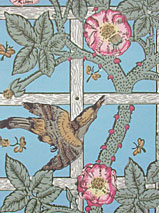
Trellis Detail wallpaper from 1864.
One of Morris’ earliest wallpaper designs was ‘Trellis’. Originally ‘Trellis’ was printed as a hand blocked design – using 11 hand-carved pearwood blocks – at great expense.
‘Trellis’ was reissued early in the the 21st century printed on Surface Print machines. This design was a triumph of the art of surface printing.
‘Trellis’ was designed by Morris, and drawn in collaboration with his good friend (and architect) Philip Webb in 1862 (who did the birds as Morris thought himself incapable of drawing birds).
‘Trellis’ was inspired by the rose trellis that ran along the garden at Morris’ own Red House, which was designed by Philip Webb, and built in 1859.
Privately owned for many years, the National Trust in England has recently purchased Red House to preserve it and open it to the public. They are actively researching how they will restore this iconic residence.

Red House, Bexleyheath, near London, England. Built 1859 for William Morris, designed by Philip Webb, architect 1831-1915
Red House where Morris lived from 1859 to 1865, was actually known for its white walls, which were regarded as remarkably bare by the tastes of the 1860’s.
Morris’s interiors were usually designed by his firm of Morris, Marshall, Faulkner & Co. – “Fine Art Workmen” which was established in 1861 with six partners.
The “Firm” produced high quality decorative work by hand on a commercial basis. Stained glass, furniture, frescoes, carpets, fabrics and embroideries were produced during this period.
In 1874, the firm was reorganized and Morris & Co. was formed. A prolific period of designing took place in the 1870’s and 1880’s with Morris’ designs appealing to enthusiasts of the Arts & Crafts movement. Simpler interior design was becoming fashionable, based on natural patterns and materials.
The interiors that were designed by Morris’ firm were simpler than most interiors of the period. Where most Victorian houses were full of swagged fabrics, and gilt and ruffles, Morris’s interiors were simpler.
Pattern was very evident, though his flatter designs were quiet. Curtains were plainly sewn, although the fabrics were patterned with Morris’ distinctive designs. Furniture also was simpler, eschewing the heavy carving usually found in late Victorian rooms. Woodwork was often painted in flat finishes, in shades of white or dull, soft green. In fact, if you stand in one of Morris’ interiors, you can often count as many as seven different Morris wallpaper and fabric designs in one room. Yet, there is a similarity of style that binds them all together, and unifies the design of the room. The result is a restful, cozy room, that still looks fresh to today’s eyes.
Two other houses owned by the National Trust in England are available today to visit that have extensive William Morris interiors. Regrettably, The National Trust does not allow photography in its properties now, after some security issues, so we can only show exterior views.
Standen in East Grinstead

- Left: Standen – built 1894 –East Grinstead, Sussex, England. Owned by The National Trust
Right: ‘Daffodil’ fabric. Used in the morning Room at Standen
Standen in East Grinstead, Sussex, was also designed by Philip Webb. Built in 1894 in the English Queen Anne style of brick, tile-hanging and wood, it is a delightful place to visit, set on a light-filled hillside, with wonderful gardens, a fern grotto and a conservatory (and a tea room and gift shop!)
The Dining Room, with its green-painted wainscot and blue and white china on oak shelves, is a distinctive Webb design.
Other rooms have been furnished with Morris wallpapers, fabrics and upholstery. It is good to see them in the setting that they were originally chosen for. Designs to be seen at Standen include: Trellis wallpaper (in the hallway); Daffodil fabric; Tulip chintz and Willow Bough wallpaper, among others.
Wightwick Manor in Wolverhampton

- Wightwick Manor, near Wolverhampton. Built in 1887 and 1893. Now owned by The National Trust. One of the best Morris interiors available to visit, with Pre-Raphaelite paintings and Victorian gardens and woodlands. Image © S.Stark

- ‘Pimpernel’ wallpaper. Designed in 1876. This design was sed in the Dining Room at Wightwick.
- Image © Charles Rupert Designs Limited
Wightwick Manor (pronounced “Wittick”) near Wolverhampton, is now owned by The National Trust.
Set in a garden of clipped topiary bushes, Wightwick gives a darker, richer version of Morris interiors. Filled with dark wood, nooks, beamed ceilings and stained glass windows, Wightwick is a Tudor medieval-revival house.
Morris designs to be seen at Wightwick Manor include: Pimpernel wallpaper in the Billiard Room; Cray cotton; Honeysuckle – in linen used as a wallcovering; and Wild Tulip wallpaper in the Dining Room.

- This colourway of Wild Tulip Wallpaper was used in the Dining Room at Wightwick. Designed in 1884, it was based on an Italian cut velvet acquired by the Victoria & Albert museum in 1883.
The Influence of William Morris
William Morris, speaking at a lecture in 1882, said:
“ Whatever you have in your rooms, think first of the walls; for they are that which makes your house and home; and if you don’t make some sacrifice in their favour, you will find that your chambers have a kind of makeshift lodging appearance about them, however rich and handsome your movables may be.”
Morris wallpapers, though designed in England, were historically exported, and used around the world. There are extensive collections in Australia, Canada, and the United States. Today, one of the largest markets for Morris designs is in Japan.
After seeing real Morris interiors – or even photographs of them – one can understand why Morris’ designs have been in continuous production for over 130 years, which speaks to their enduring appeal. His designs were at the forefront of the development of the Arts & Crafts movement in England, and are just as appropriate for today’s restoration or construction of Arts & Crafts style homes in North America.
Further Reading – Two of many superb books available:
William Morris Decor and Design by Elizabeth Wilhide 1991 Harry Abrams
William Morris – Edited by Linda Parry 1996 V&A Museum